
Police response to Government plans on social media age restrictions
Policing leaders have responded to the UK Government’s announcement of new measures to strengthen protections for children online, including plans to introduce minimum age restrictions on social media use.
Today, Monday 15 June, the Government has set out proposals to ban social media platforms from offering services to under-16s, alongside additional safeguards aimed at tackling harmful online activity and improving children’s safety in digital environments. The move is part of a broader package of reforms designed to address concerns about online harm, exploitation and the impact of social media on young people’s wellbeing.
Under the plans, major platforms such as TikTok, Instagram, Facebook and Snapchat could be blocked for under-16s, with further restrictions proposed on features such as livestreaming and communication with strangers.
Responding to the announcement, Acting Chief Constable Becky Riggs, National Police Chiefs’ Council (NPCC) Child Protection and Abuse Investigation (CPAI) Lead, said:
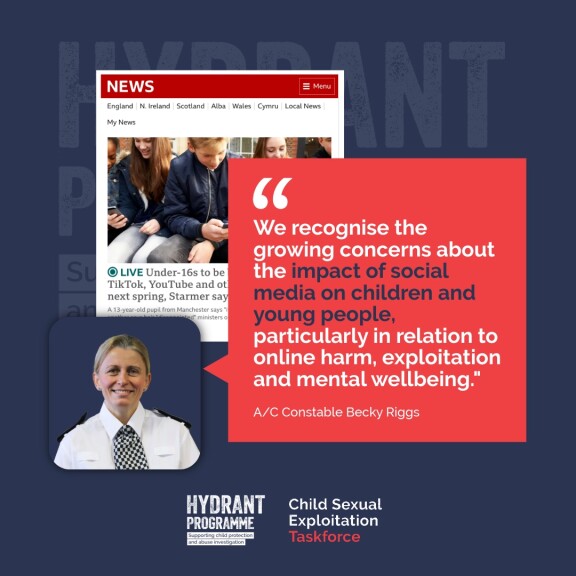
"We recognise the growing concerns about the impact of social media on children and young people, particularly in relation to online harm, exploitation and mental wellbeing.
"While there are many opportunities that online environments can offer, it is essential that children are able to participate safely. At present, that is not always the case, and where environments cannot be made safe, preventing children from accessing them is one step in our broader mission to keep them protected.
"Any move towards minimum age restrictions is not a standalone solution. It must sit within a wider, system wide approach to improving online safety and reducing criminality for all users. That includes stronger platform accountability, function level regulation, and the development of effective, built in safeguards.
"Enforcement in this space requires careful consideration. Our approach needs to prioritise education, prevention and safeguarding, rather than criminalisation, particularly when dealing with children and families.
"Keeping children safe online is a shared responsibility. Policing cannot do this alone, and we will continue to work closely with partners, including industry, education and safeguarding services, to ensure the best possible outcomes for children and young people."
In addition, NPCC Chair Gavin Stephens, said:
"Risks to children online have reached intolerable levels, so measures to strengthen their safety are both urgently needed and warmly welcomed. The NPCC has been calling for stronger action for some time now, and I hope this will also be the start of a much broader conversation about online safety and how its absence has become an accelerator of crime and disorder, with the spread of misinformation posing significant harm to communities across the UK.
"This is a societal threat and one that is the responsibility of us all. A ban alone is not enough, and ongoing action is needed from policing and Government, education, communities, and particularly tech platforms themselves."
The NPCC said it will continue working closely with government, industry and safeguarding partners to support measures that improve online safety and reduce harm to children, while recognising the complexity of enforcing age-based restrictions.